DONGGUAN KEQI AUTOMATION EQUIPMENT CO.,LTD
hxq@keqi-auto.com
- All
- Product Name
- Product Keyword
- Product Model
- Product Summary
- Product Description
- Multi Field Search

Views: 213 Author: Site Editor Publish Time: 2022-04-22 Origin: Site
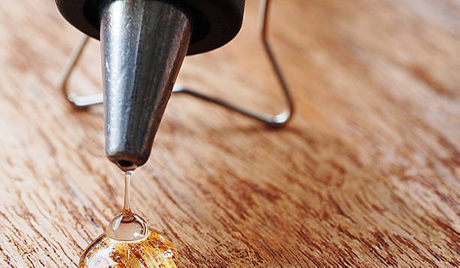
Hot melt adhesive powder needs to be bonded by pressing, sprinkling hot-melt adhesive powder on the surface of the clothes to be bonded, and then pressing the molten adhesive powder to bond. The hot-melt glue stick is heated and melted by a hot-melt glue gun, and the hot-melt glue is heated and melted by a hot-melt glue machine or a hot-melt glue furnace.
In addition, since most of the fabrics are treated with steam during the coagulation process, the glue is required to have the characteristics of high-temperature steam resistance, the softening point is required to be higher than 115°C, and the appropriate crystallinity is required. Improve the thermal stability of rubber. For example, polyamide is used as the matrix, and its lower limit content is 45% (mass fraction). Hot melt adhesives with lower processing viscosity are required for fibrous fabrics with excellent softness.
Can significantly reduce the labor intensity of garments by gluing and sewing, and the high imitation garments made are perfect, fit, and firm. Hot melt adhesives used for fabric bonding mainly include polyamides, polyphenols, and polyurethanes.
The adhesive lining is made by hot-melting rubber evenly on the fabric's surface. In use, the adhesive interlining is cut to the desired shape and size, and the side on which the PUR hot melt adhesive is applied is thermally bonded to the back of the other fabric material.
It is arranged in the high imitation clothing layer, and serves as the skeleton of the high imitation clothing, which simplifies the processing and time of the high imitation clothing, making the high imitation clothing light, beautiful, comfortable, maintains its shape, can be washed, and is durable. Interlining processing usually requires that the hot melt adhesive is colorless, odorless, soft, fast, drying, and moisture resistant, and the adhesive does not affect the fabric and is lightfast.
A variety of hot melt adhesives are available for lining processing. Almost all types of hot melt adhesives can be used. The most commonly used are ethylene-vinyl acetate (EVA) hotmelts, polyamide hotmelts, and high-pressure polyethylene (HDPE) hot melts. Melt powders and hot melt adhesives and processing methods vary for different applications.
Carpets used for hot melt adhesives are mainly copolymers of ethylene and other olefinic monomers, such as ethylene-vinyl acetate copolymers, and ethylene acrylate copolymers, etc. In most cases, ethylene-vinyl acetate copolymer (EVA) is used.

 Hot melt adhesives and PUR hot melt adhesives are the most commonly used adhesives in textile processing, especially for high imitation garments. It is widely used for bonding non-woven fabrics, carpet seams, fabric linings, zippers, etc. Hot melt adhesives used in the textile industry must have good bond strength, excellent softness, and wash/dry cleaning resistance.